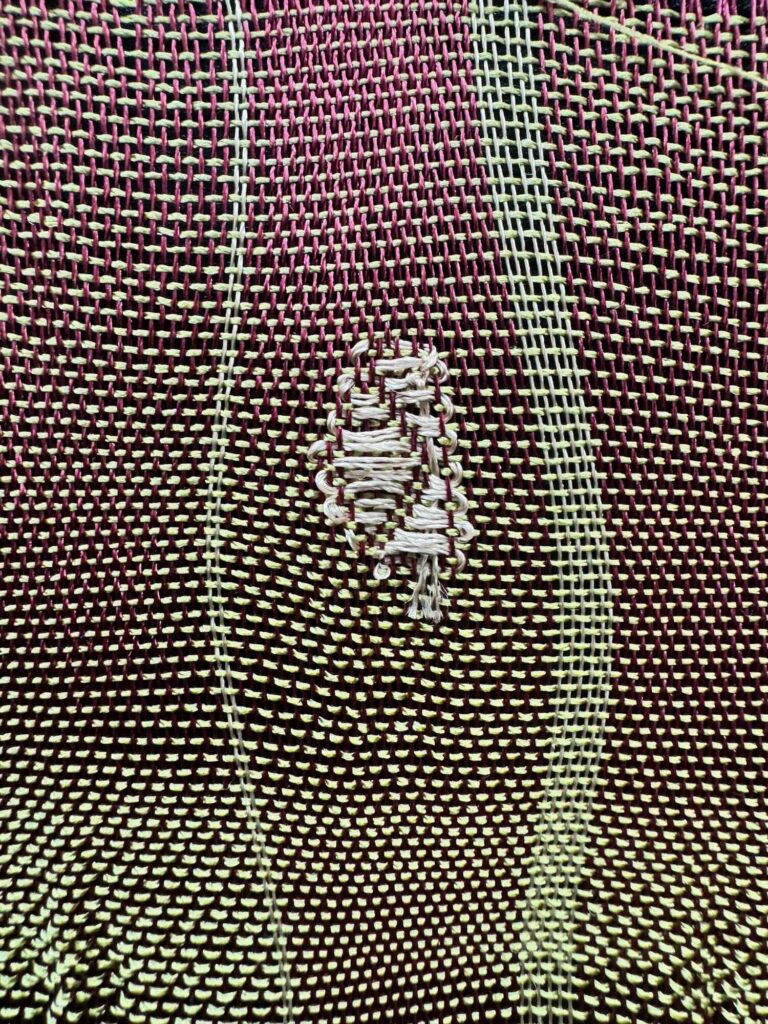
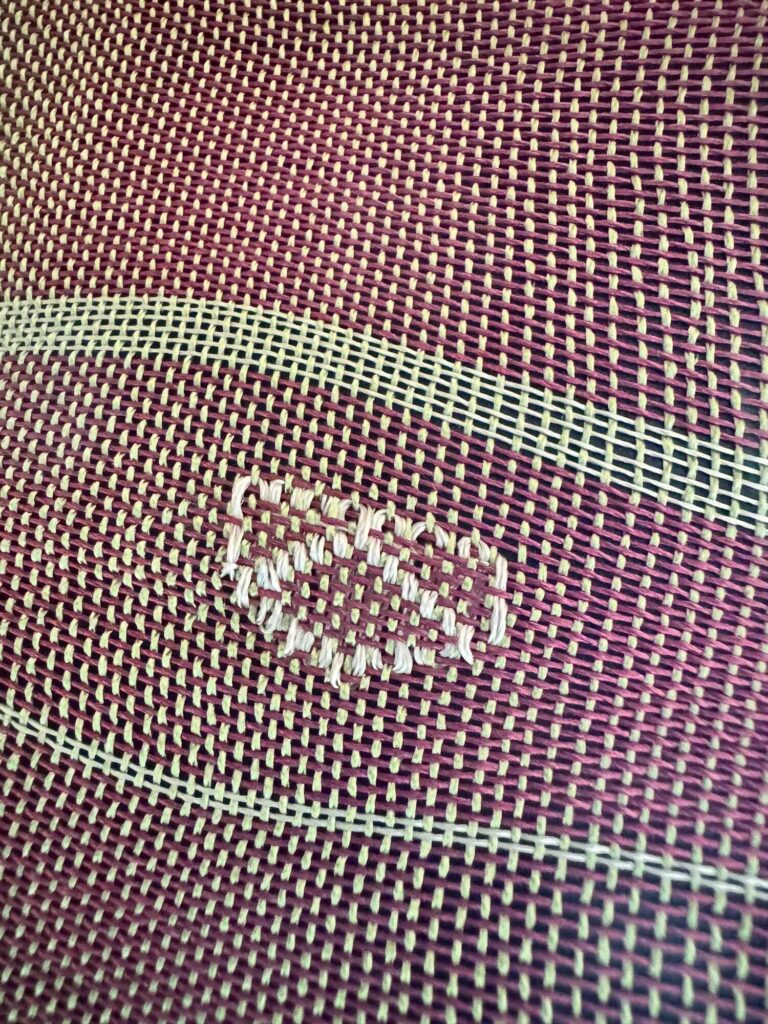
I offered to make a scarf as a gift for a friend. She looked at the samples woven in Warp 53 and decided that she liked the effect of the rayon yarn. She chose colours and left the rest to me.

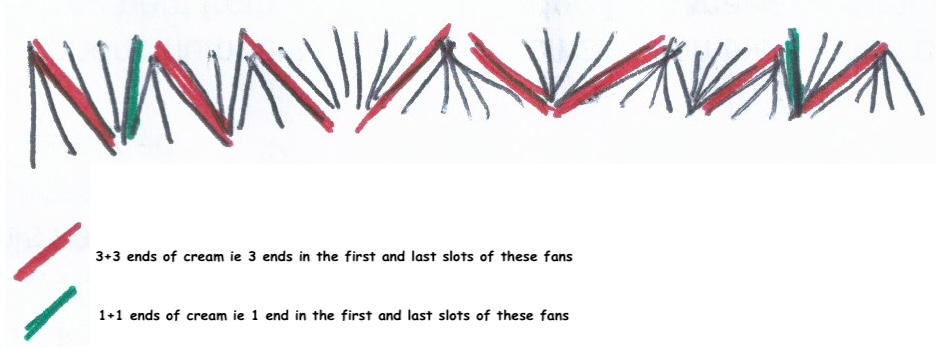
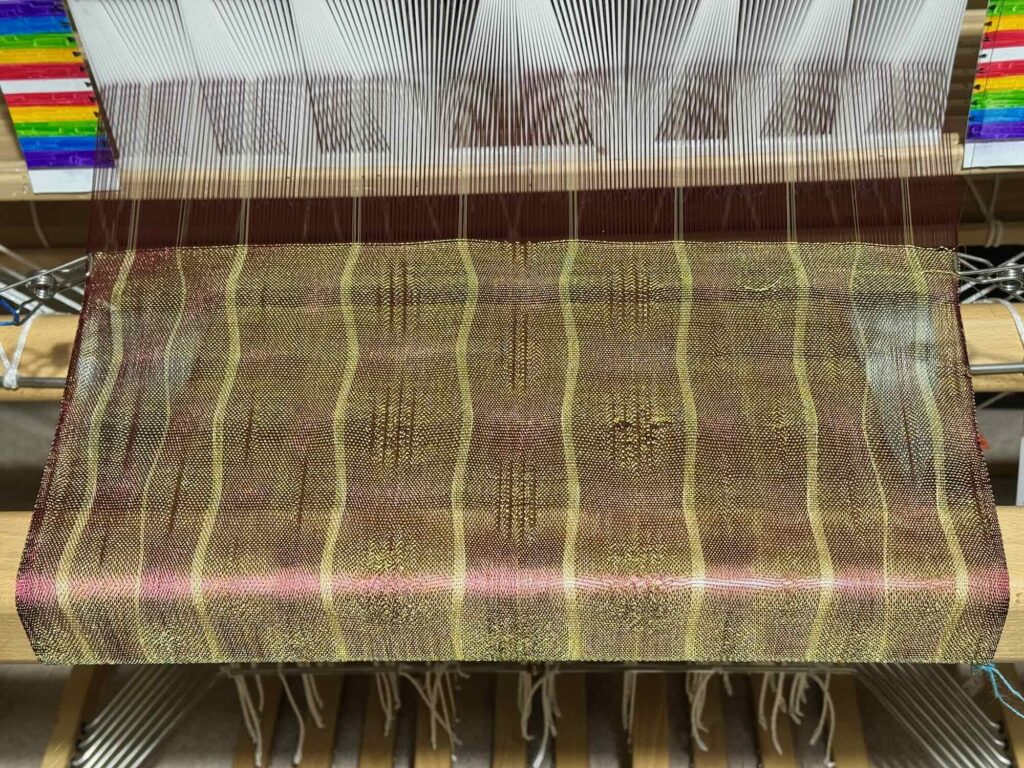
This reed arrangement gives me 190 slots with 3 ends per slot ie 570 warp ends in total. Based on the fabric woven in Warp 53 with this same yarn, I should end up with fabric that is about 40cm wide. The reed & warp arrangement can be seen in the first photo below.
The warp yarn is fine rayon and will be wound with 2 ends in hand (burgundy only) with a length of 5m (~2m/scarf).
Warp winding order:
30 burgundy (10 slots of half fan)
6 cream (first & last slot of fan sections)
32 burgundy (11 slots of half fan)
2 cream (1 end added to the 2 ends of burgundy in each off the first and last slots of the fan sections)
32 burgundy (11 slots of half fan)
6 cream (first & last slot of fan sections)
66 burgundy (22 slots)
6 cream (first & last slot of fan sections)
66 burgundy (22 slots)
6 cream (first & last slot of fan sections)
66 burgundy (22 slots)
6 cream (first & last slot of fan sections)
66 burgundy (22 slots)
6 cream (first & last slot of fan sections)
66 burgundy (22 slots)
6 cream (first & last slot of fan sections)
32 burgundy (11 slots of half fan)
2 cream (1 end added to the 2 ends of burgundy in each off the first and last slots of the fan sections)
32 burgundy (11 slots of half fan)
6 cream (first & last slot of fan sections)
30 burgundy (10 slots of half fan)
This gives me a total of 570 warp ends, 190 reed dents, 3 ends per dent, 6 ends per raddle slot, 48cm width on loom, heddles threaded in a straight draw on shafts 1-8 moving from right to left.
YES! it is complicated to work out!!
Once the warp was wound, I removed it from the warping mill in a tight chain as normal. This rayon yarn is INCREDIBLY slippery to work with. Because of the slipperiness, I needed husband to help me get the warp onto the loom – he pulled the yarn tight as I wound it onto the warp beam and helped keep the ends from falling off the lease sticks when I cut the end of the warp.
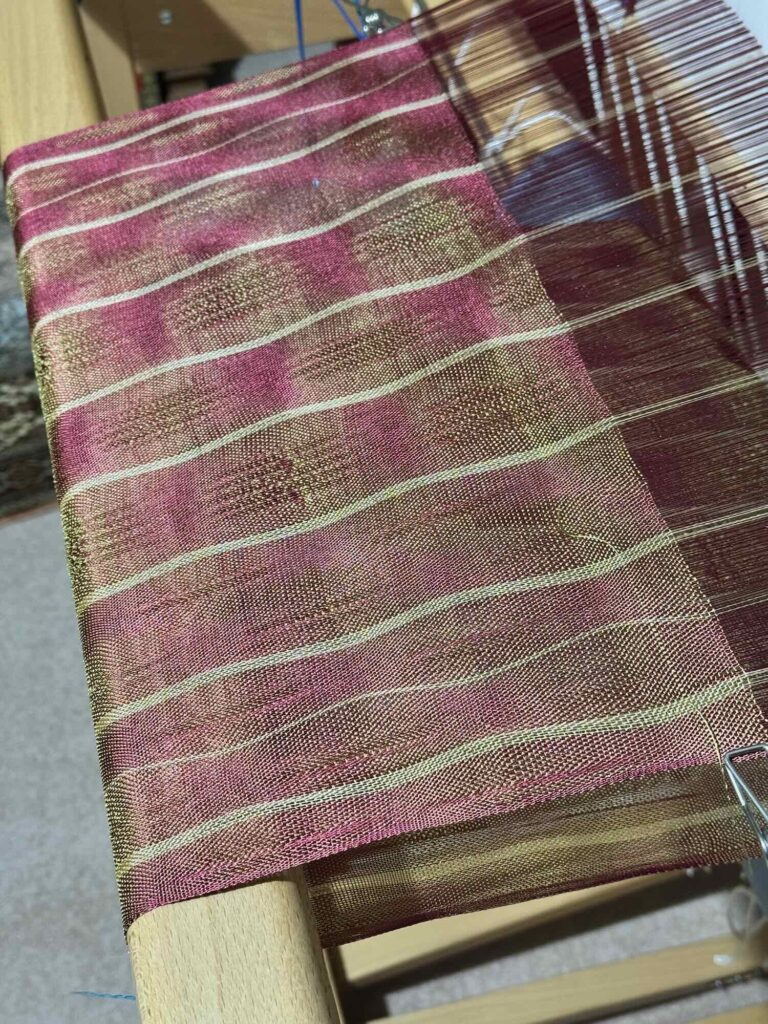
After hemstitching, I began to weave. I began at the lowest reed position and wove 20 picks. I then wove 6 picks per position band with 12 picks at the turning points for 4 down/up cycles of the reed – however, I only wove at every second vertical position band ie Blue/Yellow/White/Yellow/Blue until I had 2m of woven fabric. A single reed position cycle of up and down gave me ~7.5cm of fabric and took ~20 minutes to complete.
I discovered that the best way to weave with this slippery yarn was to bring the reed to the fell of the cloth and pull, open the opposite shed, push the beater back (with the opposite shed open), throw the shuttle, close the shed and repeat.
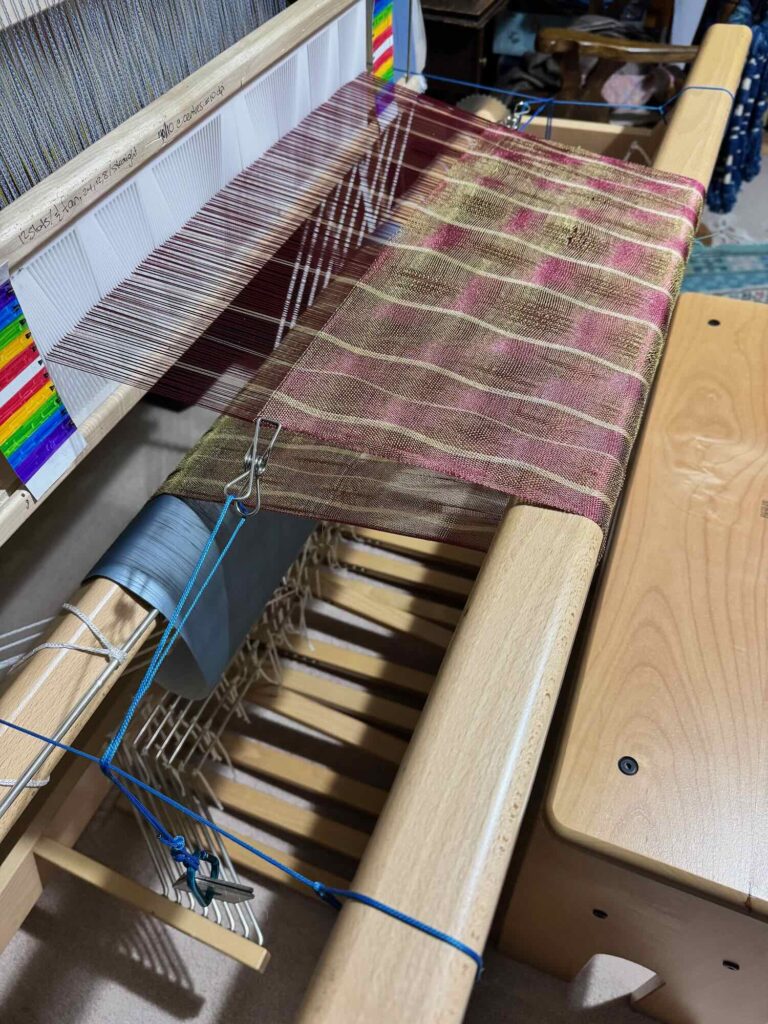
I decided to weight the edges of the fabric to help prevent draw-in. I used very strong clothes pegs, thin rope, a carabiner clip and large square washers (see below). I moved these along the edges as required to keep the fabric from pulling in.
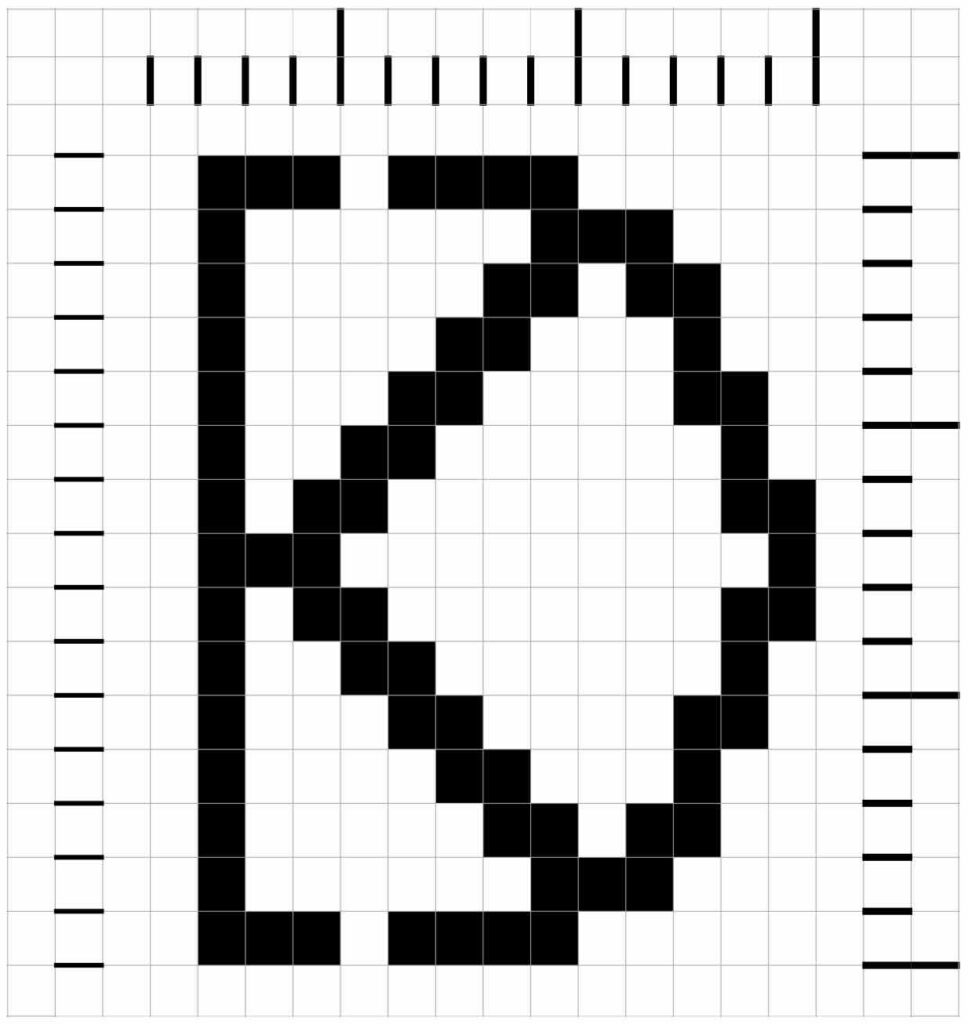
I have decided not to sew labels onto scarves anymore so drew out my “logo” on graph paper so that I can weave it into the fabric using supplementary weft yarn. The supplementary weft yarn would be the same as the pattern weft, but in a contrasting colour and would be doubled over to make it thicker. I had meant to weave this in at the start of the fabric, but forgot. I wove it near the end of the fabric instead which meant weaving it in upside down. I had to make minor changes to the graph paper pattern in order to prevent unweaving if the supplementary weft was not caught by a warp thread or the pattern weft.
Once I had ~2m of fabric, I hemstitched, left a gap and prepared to weave the second scarf on this warp.