It was time to try the 3D printed fan reed. Rather than weaving something really wide and using ALL of the 3D printed fan reed sections, I decided to try just a few of the sections. I decided on the following layout of the reed sections – this gives me a total of 128 slots (or dents) in the reed, sleyed at 30dpi (ie 3/dent).
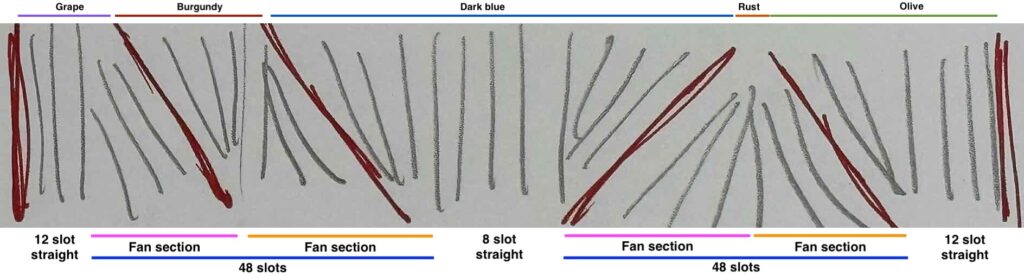
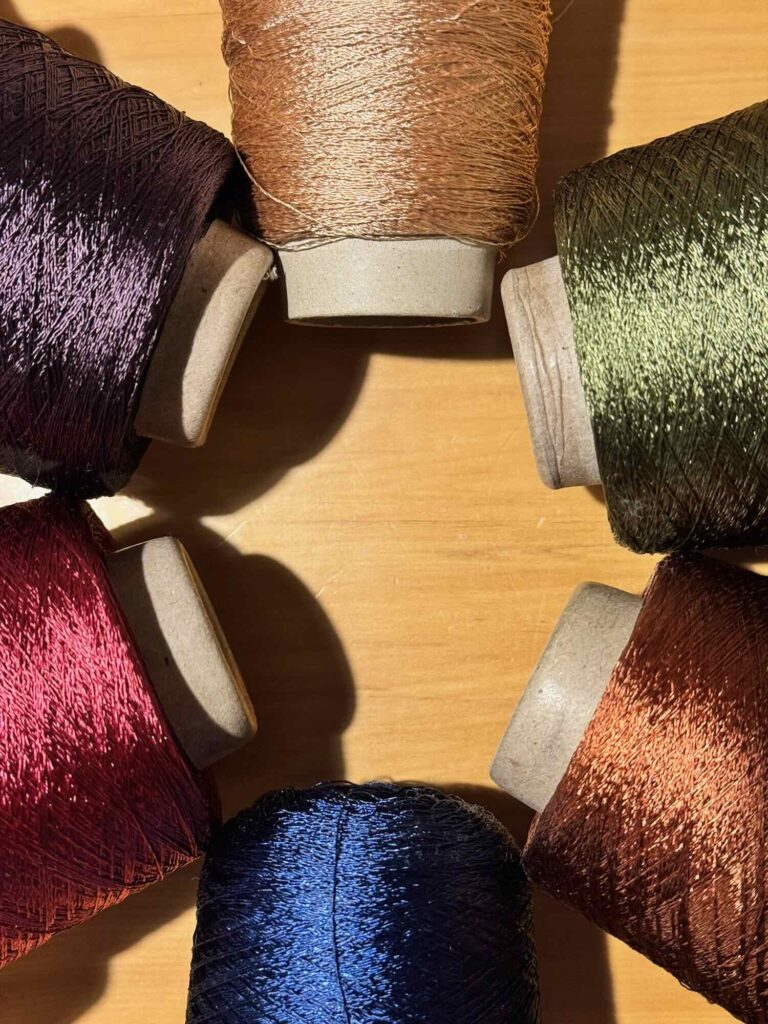
The warp yarn is fine rayon and will be wound with 2 ends in hand with a length of 2m.
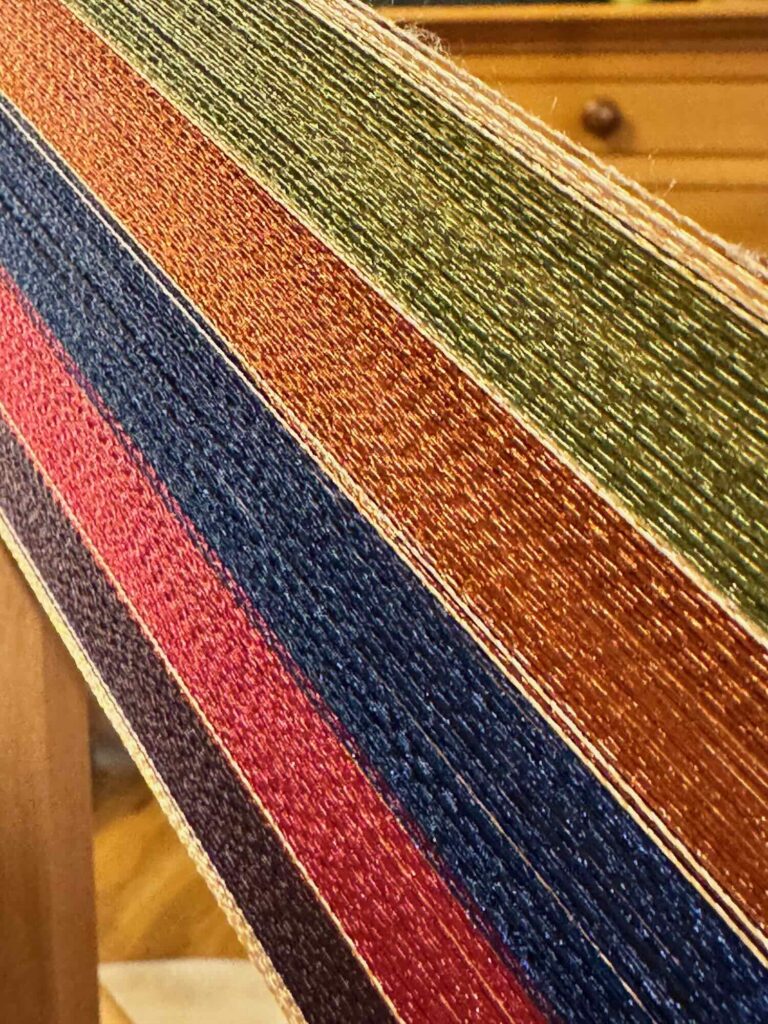
I want 5 colours in the warp – grape, burgundy, dark blue, rust, olive with zingers of pink gold separating each of the colours (these are the red lines in the image above).
Warp winding order:
9 zinger (3 straight reed dents)
60 grape (9 straight + 11 fan dents)
6 zinger (2 reed dents – 1 at the end of each fan section)
66 burgundy (11 dents in each of 2 fan sections)
6 zinger (2 reed dents – 1 at the end of each fan section)
90 dark blue (11 dents in fan section + 8 dents in straight + 11 dents in fan section)
6 zinger (2 reed dents – 1 at the end of each fan section)
66 rust (11 dents in each of 2 fan sections)
6 zinger (2 reed dents – 1 at the end of each fan section)
60 olive (11 fan dents + 9 straight)
9 zinger (3 straight reed dents)
For a total of 384 warp ends, 128 reed dents, 6 ends per raddle slot, 32cm width on loom, heddles threaded in a straight draw on shafts 1-8 moving from right to left.
YES! it is complicated to work out!!
I want to look at
1) the functionality of the 3D printed fan reed sections
2) the use of rayon as a warp yarn
3) the use of fan reed sections in a slant (burgundy yarn section) and a fan (dark blue & rust yarn sections)
4) the use of different colours of weft yarn (black and cream)
5) the use of different weft yarns (rayon, 60/2 cotton and 16/2 cotton – see image below)
Once the warp was wound, I removed it from the warping mill in a tight chain as normal. This rayon yarn is INCREDIBLY slippery to work with. Because of the slipperiness, I needed husband to help me get the warp onto the loom – he pulled the yarn tight as I wound it onto the warp beam and helped keep the ends from falling off the lease sticks when I cut the end of the warp.

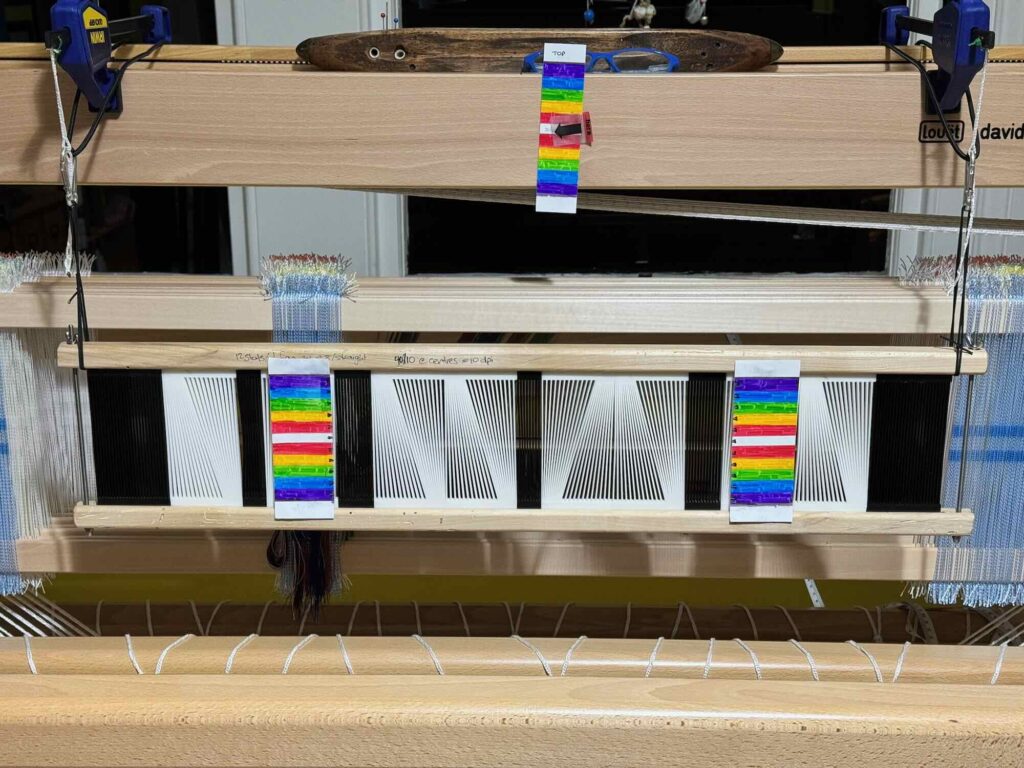
After hemstitching, I began to weave. As with the stainless steel fan reed, I began at the central white band and wove 6 picks per colour band with 12 at the turning points. I found that I couldn’t weave the bands furthest away from the centre (purple) as the slots in the reed were too tight to allow the yarn to slide through. This means that I was able to go about 4cm above and below the central band.
The slippery rayon yarn was not difficult to weave with if I kept it under a reasonable tension. I was able to get a nice balanced plain weave if beat the yarn against the fell of the cloth with a very firm pull of the reed.
A couple of times, I noticed a lot of fraying on the selvedge threads. I sprayed them with hairspray and wove past those sections very carefully.
Not far into the weaving, I was having difficulties advancing the warp and three of the selvedge warps on the left side frayed and broke; I just left them hanging from the warp beam and continued weaving without them. The reason that they broke was that I inserted a spacer stick incorrectly which ended up pulling those ends too tightly and stopping the warp from advancing. After I corrected the spacer position, all was well.
WEFT YARN 1 (black rayon). I wove from the central white band up to the blue, down to the blue and then up to the blue again. I wove 6 picks per colour band and 12 turns at the blue turning points.
After completing this, I threw two picks of red wool yarn as a marker.
WEFT YARN 2 (cream rayon – same yarn as the warp zingers). I wove 3 picks per position band and 9 at the turning points for a down, up, down cycle. Then I wove 3 picks per position and 6 at the turning points for an up, down, up cycle of vertical band positions. I threw 2 picks of red wool as a marker.
WEFT YARN 3 (60/2 black cotton weft yarn). I wove 6 picks per position band with 12 picks at the turning points for 4 down/up cycles of the reed – however, I only wove at every second vertical position band ie Blue/Yellow/White/Yellow/Blue. I finished with 2 picks of red wool as a marker.
WEFT YARN 4 (60/2 cream cotton weft yarn). I wove 2 picks per position band and 4 picks at the turning points for 3 down/up cycles of the reed. I finished with 2 picks of red wool as a marker.
WEFT YARN 5 (16/2 black cotton yarn). As with the 60/2 black cotton yarn, I wove 6 picks per position band with 12 picks at the turning points for 4 down/up cycles of the reed, again I only wove at every second vertical position band ie Blue/Yellow/White/Yellow/Blue. I finished with 2 picks of red wool as a marker.
In order to clearly differentiate between ends of the sample, I wove a further 11 picks of 16/2 black cotton at the top blue reed position. I did this many to see how long it would take for the undulations to settle into a constant position.
I then hemstitched in bundles of 3 ends (started with 6, but went to 3 as it looks much nicer).
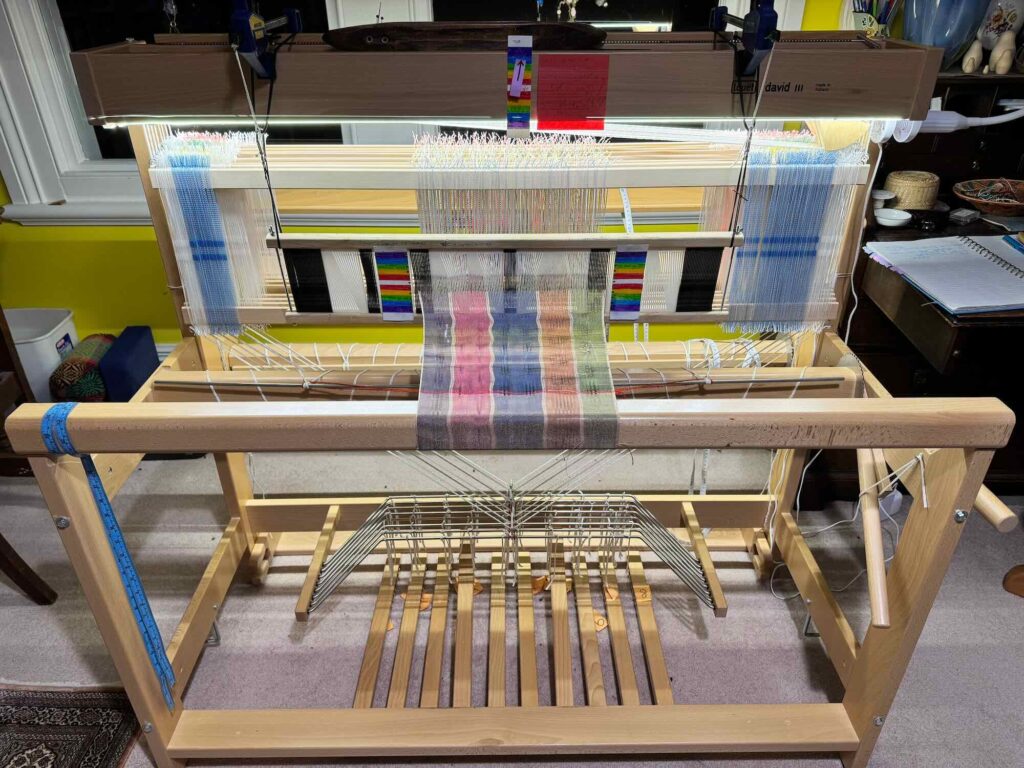
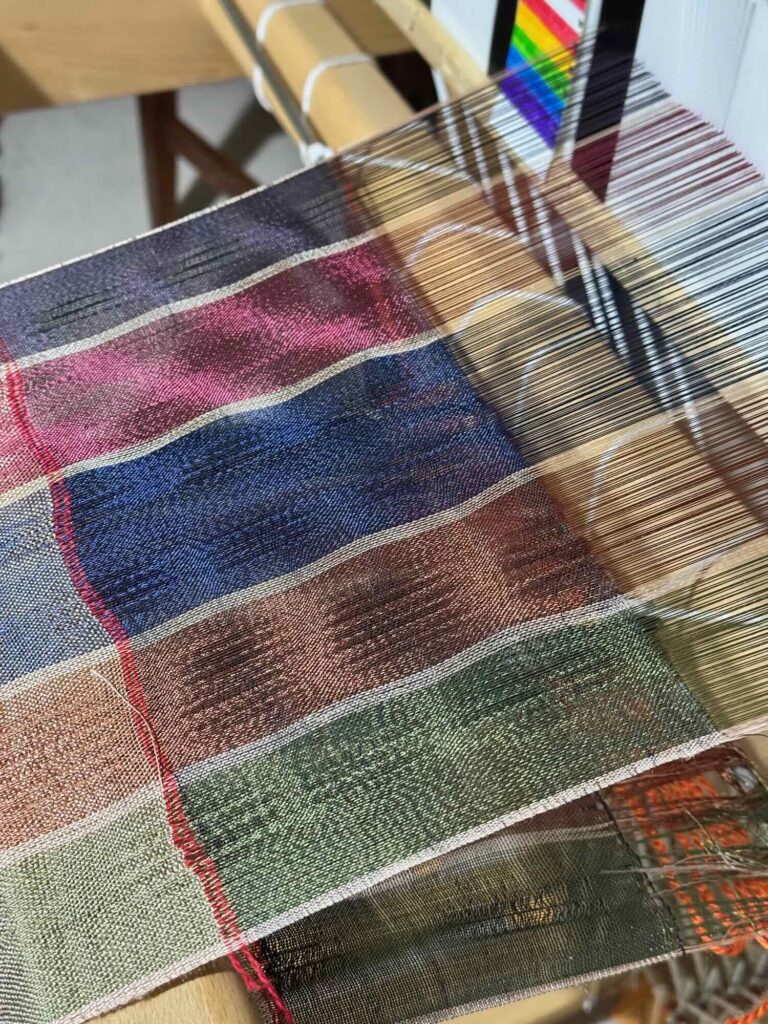
I decided to weave off the remainder of the warp using rayon yarns – a band of each of the colours that are in the warp and a band of black. I started with the grape yarn, and continued with burgundy, dark blue, rust, olive and black. I aimed to make each weft band the same height as the width of the corresponding warp stripe.
I hemstitched at the top blue band using bundles of 3 warp threads. The entire piece was woven using the same reed position plan – 6 picks/position band with 12 picks at the turning points but using only every second position band (Blue/Yellow/White/Yellow/Blue).
Reed movement cycles were Grape weft = down/up; Burgundy weft = down/up; Dark blue = down/up/down; Rust = up/down; Olive = up/down; Black = up/down/up/down.
I finished by hemstitching at the bottom blue position band.
The fabric was then taken from the loom and the two pieces cut apart. I trimmed the fringes with a rotary cutter and metal ruler. The fabric was hand washed in warm water with Unicorn Beyond Fibre wash, loose ends were trimmed and the fabric pressed on a rayon setting. It was then laid out to dry.
| Piece | Pre-wash | Post-wash | Weight |
| Yarn types | 27 (rayon) -28cm (16/2 cotton) x 80.5cm | 25.5-27.5cm x 78.5cm | 32g |
| Rayon colours | 27.5-28cm x 46cm | 26.5-28.5cm x 43.5cm | 19g |
Yarn type sample
Rayon weft – A little distortion at the wide parts of the undulations, slight puckering at these areas. The distortion and puckering are more noticeable with the cream rayon weft than the black rayon weft. Both weft colours are very effective.
60/2 cotton weft – Too much distortion in the wide part of the undulations and more puckering at these areas. I don’t like the cream weft at all, it detracts from the warp colours.
16/2 cotton weft – Very little distortion of the fabric web, slight puckers at the wide points.
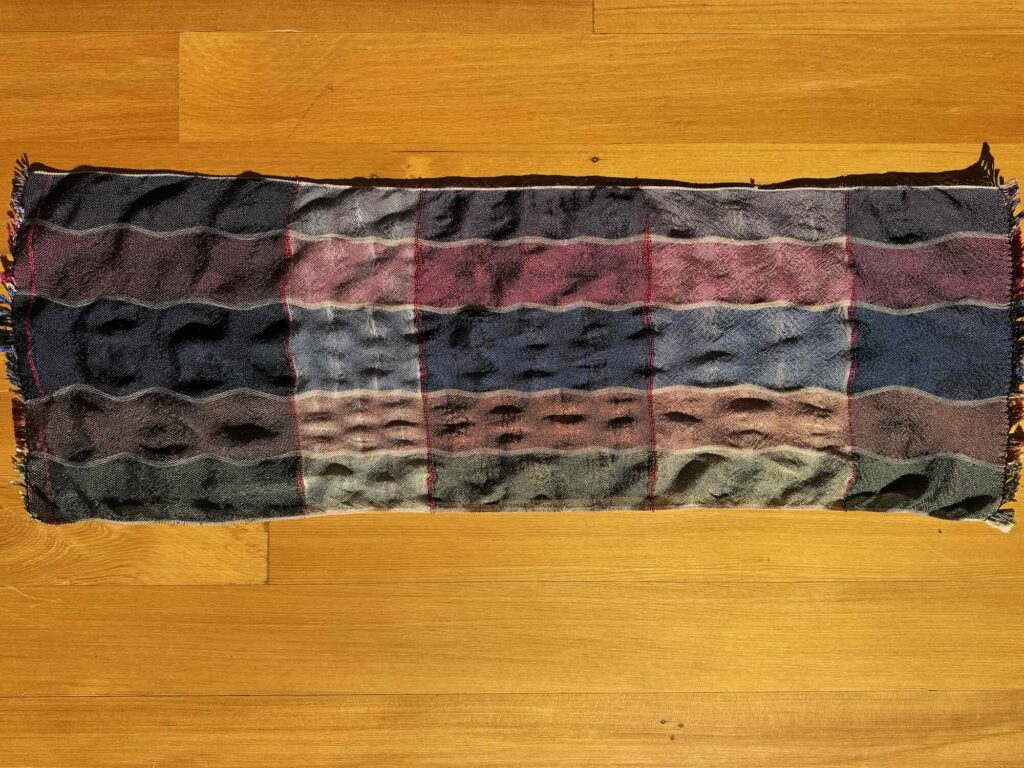
Rayon weft colour sample
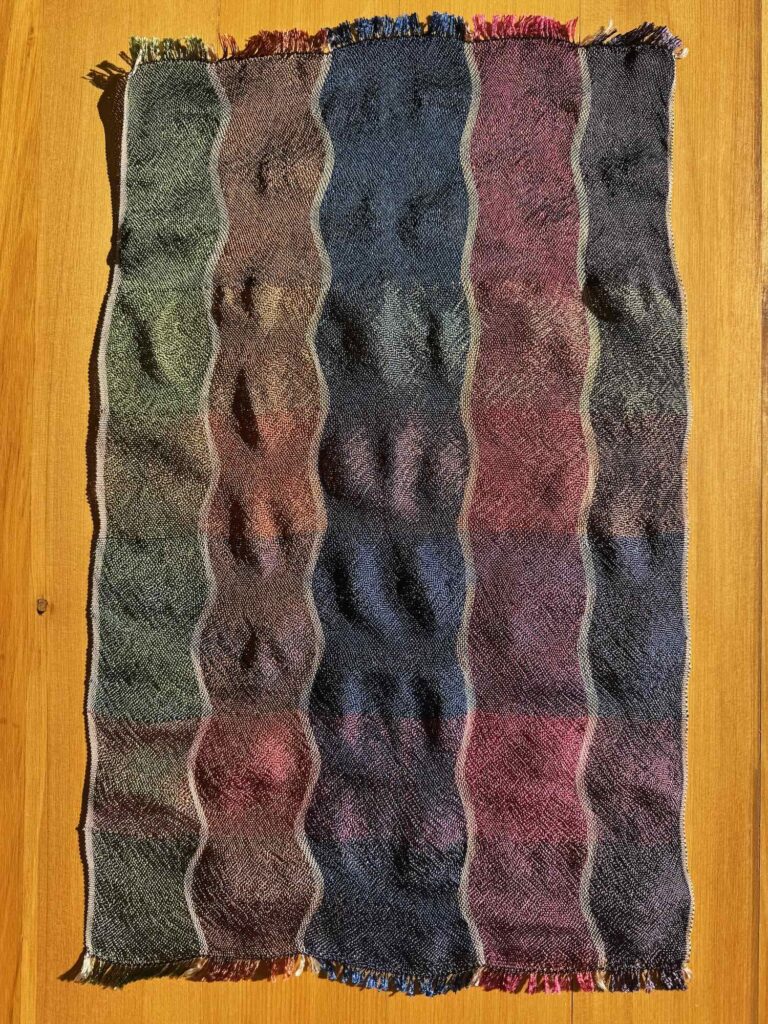
I like the thread movement at the wide parts of the undulation – it creates interesting lines in the plain weave fabric.
There are slight distortions/puckerings.
The iridescence and shine are beautiful! Particularly in the red/blue and the red/green sections.
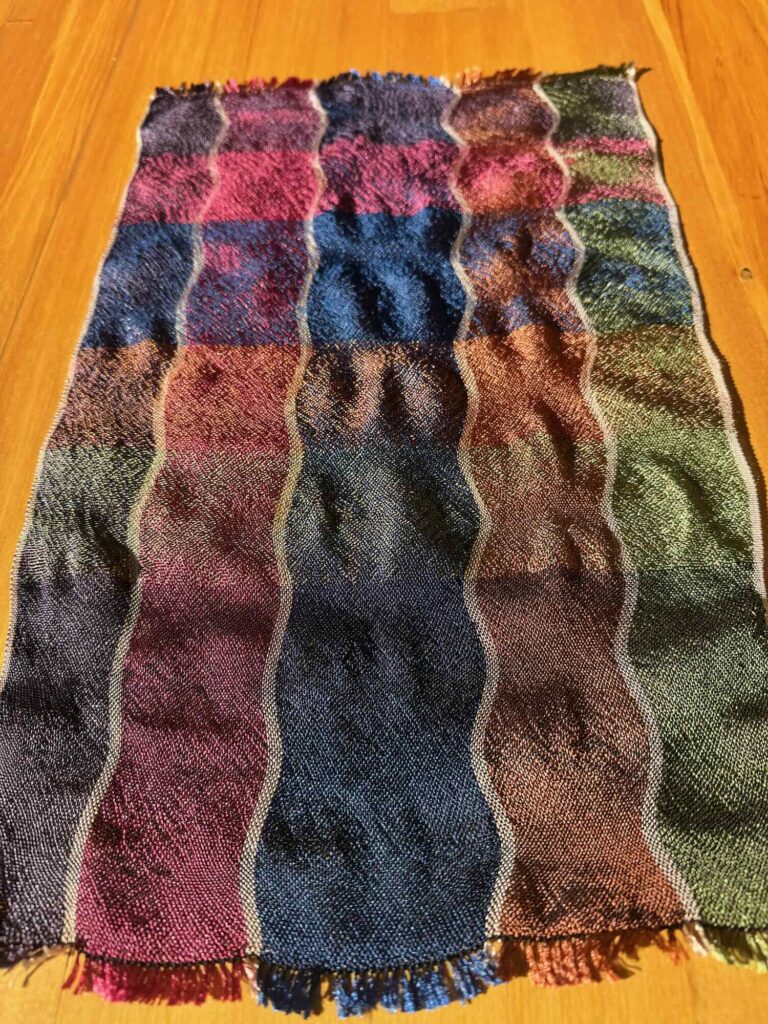
Overall
I think the most effective undulations were achieved by weaving 6 picks at every second vertical reed position.
I like the straight edges, they are very neat looking.
I like the drape of the rayon weft/rayon warp fabric, although it is a little harder to the touch than silk or cotton.
I really like the shine and iridescence.
I think that the effect of the undulations shows best with two different colours, especially with strongly contrasting colours.
I quite like the burgundy stripe (parallel undulations) as it has two miniature fan reed wide/narrow effects going on. I also like the rust stripe (opposing undulations). The dark blue is very wide (has a straight in between the fan sections) and would make a nice variation in a piece.
I am really pleased with how the 3D printed fan reed performed and with the rayon yarns.